
Guadalquivir canoe - D
A few miles downstream from Almodóvar del
Rio on Spain’s Guadalquivir River, I saw what I’d been dreading for days:
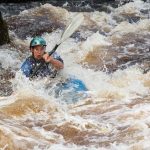
my wife, Rosalie, and our 17-year-old daughter, Anna, chest deep in fast
water, their loaded kayak turned perpendicular to the current and pressed
against a tree that had fallen from the bank.
They had been paddling ahead, down a narrow channel with steep, wooded
banks and around a blind right turn when they were swept into the snag.
Following in the boat I shared with our two younger girls, Margaret, 13,
and Mary, 7, I pulled up on a gravel beach and studied the water between
us and the troubled kayak. Too muddy to see through. If it was shallow,
I could walk. If it got deep, I’d be swept downstream. I took a step and
quickly it was up to my thighs.
Out in the river, Rosalie and Anna spoke evenly to one another, calmly
discussing their plan. The current piled up water on their backs and against
the sit-on-top fiberglass boat that was strapped with three heavy dry bags
(which were soon to be wet bags) filled with clothes and camping gear.
When I took another step, the warm water rose to my waist while a cold
lump formed in my stomach.
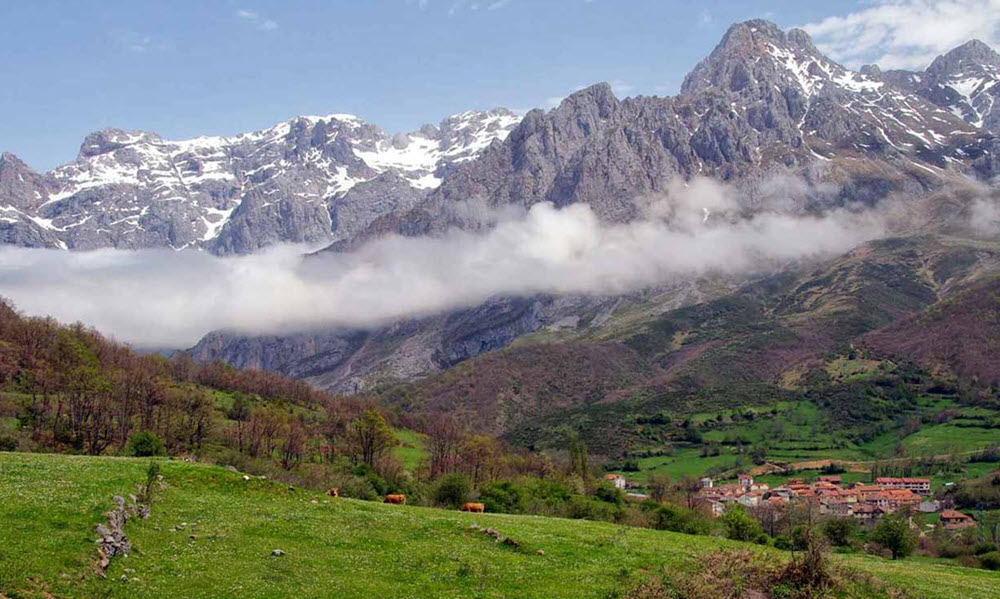
The Guadalquivir River flows westward for 408 miles, falling through
the cedar and pine forests of the Sierra de Cazorla, winding across southern
Spain’s searing Andalusian plain, and spreading to almost a mile wide before
emptying into the Atlantic. We paddled about 230 miles of it, skipping
the Class IV and V rapids up high, and long stretches of reservoirs in
the middle. The day we caught the snag, or the snag caught us, was Day
20 of a 28-day trip from the mountains to the sea.
I planned this adventure to snap my family out of our domestic patterns—to
force us to work together through difficult days, and to relax together
through easy ones. Our excursion was water-oriented because I’m a part-time
river guide and because my wife and daughters love any plan that involves
camping and floating; Rosalie chose Spain because we both speak Spanish.
She said I’d combined a midlife crisis with a family Outward Bound course,
and perhaps she’s right. I didn’t want a wilderness trip, though. We live
in Montana and we’ve floated wild rivers. I wanted a flatwater trip through
history, so I picked one that’s been a working waterway for thousands of
years.
The Greeks called it Tartessos, the Romans Baetis, and the Arabs named
it Wadi al-Kebir, which eventually morphed into the Spanish, Guadalquivir
(gwad-al-key-VEER), or Great River. The Phoenicians shipped metals home
on its water. The Romans shipped pottery and olive oil. And up its estuary
to the port of Seville came gold of the Aztecs and Incas. Hercules, Jonas,
Caesar, and Cervantes had come this way, so why not the Cates family?
It was late afternoon, when the sun ought to be starting to set. But
not in Andalusia, where rather than traverse the sky in a simple arc, the
summer sun travels in slow, torturous loops. Rosalie and Anna worked the
bow of the yellow kayak up through the branches of the snag until its weight
lay across the trunk. Now only the stern was still propped up onto the
tree. This was the tricky part. The bow line Rosalie held in her hand wasn’t
long enough. If they pushed the kayak any farther, she’d have to let go
of the rope before the stern was clear. And if she let go, the kayak and
gear would wash downstream into yet another snag. I stood waist deep in
the water, and behind me Margaret and Mary sat in our beached kayak, singing
to stay calm.
Nowadays the Guadalquivir turns turbines in big dams to make electricity.
It’s pumped and divided to irrigate corn, cotton, tomatoes, strawberries,
and rice. It swells in winter rains, fills reservoirs, and in some places
dries to a trickle in the summer sun. It smells variously of olive oil,
paper mill, sheep manure, eucalyptus, and willows.
Shuttled 300 miles east from Seville, we’re dropped off in the mountains
with our rented kayaks, gear, a cell phone, and a list of people—assembled
by the woman who rented us the kayaks—who volunteered to help when we need
it. The river here is flat, milky green, and fast. It’s four or five yards
wide, but branches and vines stretch over the water, tunneling the passage,
or blocking it altogether.
This isn’t a user-friendly river. There are no boat landings or accurate
river maps. Our only plan, besides moving downstream a little each day,
is to stay safe, and to find comforts where we can. So after mornings of
paddling, scouting routes around dams, heavy lifting, and yes, tantrums,
we spend siesta hours in the shade. We play cribbage, read poems or plays
aloud, sing, and nap. We walk to the frequent riverside villages to fill
water jugs, to buy groceries and beer, coffee and ice cream.
We camp on steep banks, sandy banks, muddy banks, rocky banks. We listen
to the hum of a million insect wings, uncountable songbirds, an occasional
rooster or mourning dove, the jangle of sheep and goat bells, and as night
falls, the croaking of 10,000 frogs. There are no legal limits to where
we can camp—the riverbank is public—so we set up our two tents under the
13th-century San Pedro hermitage in El Carpio, or near an ancient watchtower,
or, stranded by fading light, atop a giant, humming, hydroelectric dam.
In Córdoba, we wave to people leaning over the rail of a bridge
built by the Romans. My daughters carry sketchbooks and draw a few of the
850 columns in the Mezquita, a giant 8th-century mosque, with a 16th-century
cathedral built inside. A few blocks away, Margaret gathers a crowd of
tourists by singing Pia Jesu in the Castle of the Christian Kings, home
of the Inquisition.
The river widens and turns brown on the plains. We paddle past lemon
and orange groves, past olive trees squatting in perfect grids over pale
hills. We meet boys and old men fishing for catfish, and Manuel the Shepherd
shows us his ancient Roman coin. His sheep graze through our camp while
he tells us how he found the coin in the grass by the river. Tells us how
he lost it, and then, miracle of miracles, how he found it again the next
day. Everyone greets us with a polite reserve, sometimes expressing concern
about our excursion.
Unlike in the provinces of northern Spain, paddling in Andalusia is
rare. So we see no other kayaks or canoes, and not until the last couple
of days, when the river turns salty and begins to flow backward with the
tide, do we see other boats: a trawler, a yacht, a giant ship coming in
from the sea.
The morning of the day we hit the snag, we paddled a bend and there,
on a high hill above a spreading white town, rose a many-towered castle.
We landed on a sandy bank, pocketed our money and passports, and followed
a goat herd into the village of Almodóvar del Rio.
We walked uphill through the narrow, cobbled streets until the town
ended and a steep field spread upward to the castle. We’d read about this
place. Built in the year 740, it had never been taken by force. We followed
a footpath to the big front door. Above us, we could see the slots for
archers to shoot arrows through, or to pour hot oil. We rang the bell.
A caretaker let us in and gave us a tour. We followed him to the tower
and relished our first long view of the river curving across the green
plain.
Then we descended a dark stairway and got down on our knees and peered
through a barred hole in the stone floor. That’s the dungeon, the caretaker
told us, in which Tello the Bastard, brother of Pedro de Castilla, imprisoned
his poor wife Juana de Lara until her death in 1359.
After the tour, we walked back to town and ate green olives, french
fries, and a pig’s kidney at a sidewalk cafe. A taxi took us to a public
pool, where we swam, showered, and played cards with local kids until late
afternoon. Then the same taxi picked us up and took us back to the river,
where I feared, as I always did, that the unguarded kayaks, paddles, life
jackets, and dry bags would be stolen.
Because there was no way to be vigilant—and we needed these town trips—I’d
resigned myself to fate. As Anna said one scorching afternoon walking back
to the river, “If our stuff is stolen, we’ll just have to take the bus
to the beach and have a normal vacation.”
But nothing was stolen. Not in Almodóvar or anywhere else. The
taxi dropped us off and we paddled downstream to our appointment with the
snag.
Margaret and Mary were still singing when I untied the bow line from
our beached kayak. Anna had swum across to get it, but I didn’t want her
to go back to the middle of the river. I told her to stay with her sisters,
then swam out across the current. After grabbing the snag and working my
way around the main log toward Rosalie, I saw something I hadn’t noticed
from shore: a decomposed goat tangled in the branches. Neither of us mentioned
it.
Rosalie held onto the tilting kayak so it wouldn’t wash downstream.
I leaned over the trunk, the current pushing against my back, and tied
my rope to the end of her bow line. Now we had a line long enough to let
the kayak go. I leaned farther over the trunk and flipped the line off
the tangle of branches. Then I squeezed over next to the dead goat.
Rosalie said go, and slid the kayak off the trunk as I pushed off, bow
line in my hand. I paddled and kicked hard across the 15 feet of strong
current, pulling the kayak to shore next to the other one. I hugged Anna,
and we turned to watch Rosalie work her way across. While I helped her
get her footing on the gravel, dripping, I felt awash in sunshine, in water,
and in gratitude.
On the 28th day, the wide turquoise river, smooth as glass, made a big
bend westward and in the distance lay the port of Sanlúcar de Barrameda.
White buildings spread along the south shore.
Then, to the north and west, the blue Atlantic opened like a dream.
We were tired, so that’s of course when the wind came up, and the tide
reversed. The last two miles across a broadening bay took an hour and a
half and added a little drama to the already dramatic final two days through
the estuary and tidelands: flamingos flying low in formation, a foot-long
fish leaping out of the water and smack into Rosalie’s face. Another into
Margaret’s lap. We’d paddled for hours, it seemed, with a single tree on
the horizon the only thing that wasn’t liquid or airy blue, no distance
or time, just stroke after stroke through a Dalí painting.
We landed on a beach crowded with sunbathers, and we jumped into the
water to celebrate. The past few days little Mary had been asking so many
questions about the ocean and the tide and the river, so many questions
that I simply could not answer to her satisfaction, so that finally during
one particularly grueling moment I had to tell her to stop asking me about
that stuff because I’d said every word I knew and in every order I knew
how, and still she couldn’t get the picture of the river meeting the sea.
So it was with pleasure that I could stand on the beach and point,
and say, “What’s that way, Mary?”
“The river,” she said.
“And that way?”
“The ocean.”
For the next week we lay on the beach and camped nearby. I kept my body
as still as possible, happy not to have to move anymore. We watched big
ships pass and little boats bob in the surf. The kids did handstands and
searched for shells, and we all floated far out into the water.
Floating to Montana, we said. Then we turned and floated back to Spain.
-----
We rented kayaks from Maria del Mar Berben Varon, owner of Turismo
Nautico Triana (954-28-13-82 and 687-42-01-42; tntmar@teleline.es) in Seville.
Del Mar and Maximo Vela, president of the Andalucian Paddling Federation
(954-28-25-26), shuttled us to the headwaters, and their network of friends
stowed our kayaks and gear in the big cities, where we stayed in hotels,
and gave us rides past parts of the river we elected to skip.
Officially, we needed a permit from the Confederacion Hidrografica
del Guadalquivir (954-93-95-17) to make this journey. The office never
responded to numerous inquiries, so we decided that if we were stopped
by a government official we’d pretend we couldn’t speak Spanish. We were
never stopped.
In the summer in southern Spain, the sun burns hot from 9 a.m. to
9 p.m., so we wore lots of sunscreen, broad-brimmed hats, and sometimes
long pants and long-sleeve shirts for additional protection. We brought,
but never unpacked, rain ponchos. In addition to our clothes, we carried
two tents, five sleeping bags and pads, two water jugs, and one small cooler,
which we filled semi-daily with crackers, cheese, sausage, canned tuna,
olives, powdered milk, jelly, and bread.
This article appeared originally in Outside Magazine. Reproduced
by kind permission of the author.