
Why go further afield for colourful diving? Jim
Greenfield reports from a Spanish marine reserve that has become a haven
for fish and heaven for divers
If you have ever dived the Mediterranean and wondered where the fish
life has gone, I can now tell you! It is all around the Medas Islands,
off Estartit, at the northern end of Spain's Costa Brava, which is playing
host to hundreds of divers each week who have latched on to this outstanding
area.
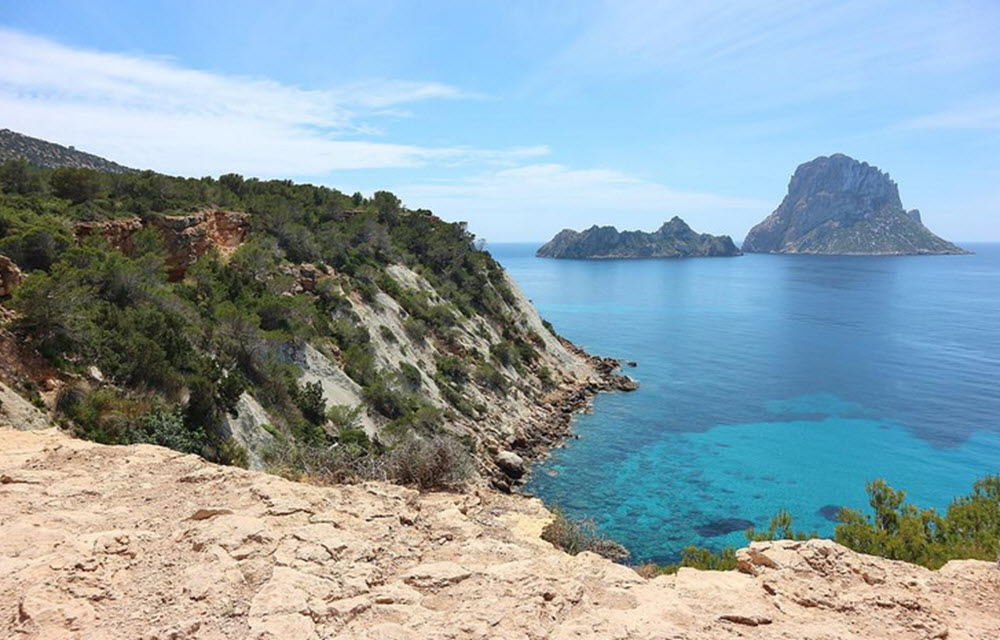
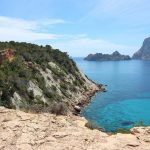
Less than a mile out of the harbour, the Medas Islands comprise two
main islands - Meda Gran and Meda Petita - with numerous large outlying
rocks and pinnacles that have been carved out by erosion and the action
of the sea. They are the seaward remnants of the limestone massif that
rises behind and dominates Estartit.
The islands are not particularly high, but the action of the sea has
eroded all but the western side, and under water the cliffs plunge away
steeply to 50m and more. Limestone is, of course, a relatively soft rock,
and the area is also well faulted. This has allowed the formation of many
tunnels, archways and complete cave systems, the most spectacular of which
goes through Meda Petita from one side of the island to the other. This
is known as the Dolphin Cave (cavern would be more appropriate) and a small,
bronze statue of a dolphin has been erected at its southern entrance. When
I say this is a spectacular cave, I do not use the word lightly: it is
huge, and makes Tyes Tunnel on St Abbs Head look like something out of
Playtime with Noddy. From the entrance at the north end, it runs more or
less level through the island at a maximum depth of 17m for a distance
of about 50m, steadily getting broader and higher as it reaches the several
entrances at the much bigger south end. You could probably drive two double-deck
buses through side by side, with room to spare! There is never a feeling
that you might not find your way out, because you are only a few fin strokes
into the system when your eyes adjust to the gloom and you can make out
blue at the other end. There are also some smaller "windows" and some perfectly
circular, vertical chimneys, which emerge somewhere on the island above.
These provide a little extra light, but it is still pretty gloomy in the
centre of the cave, and common sense dictates that a torch is carried.
I am no great fan of going into holes and caves, but I have to say that
unless you are possessed of a real phobia about being enclosed, the Dolphin
Cave is a relatively easy dive, and one that even the most jaded will find
exhilarating.
Apart from their unusual underwater geography, it has been known for
many years that these islands are biologically rather special in Mediterranean
terms, with conditions that favour the development of marine life. The
River Ter enters the sea just a few miles to the south, enriching the water
with organic material. A combination of winds and currents from the north
causes an upwelling of deeper water around the islands which brings more
nutrients from as far away as the River Rhone in southern France. All of
this creates a fertile cocktail on which many organisms thrive.
Some years ago, a far-sighted Catalan Government (the regional government
for this area) took all this on board, and realised what a treasure it
had on its doorstep. With good management it could be rejuvenated after
years of mistreatment and preserved for the benefit of diving tourists
and the local economy. So in 1983, it passed the first of a series of laws
declaring the islands a marine reserve. What an excellent decision that
has proved to be.
Although the caves are a major attraction, they are not the whole story.
Excellent dive sites abound, particularly where the cliffs go plunging
almost straight down. But the icing on the cake, thanks to the protection
afforded by the reserve, is the marine life. Many of the rock walls from
20m down are festooned with beautifully coloured sea fans; red, yellow,
purple and even combinations of these colours. They make a stunning sight.
And after years of unrestrained exploitation by commercial divers, semi-precious
red coral is again developing well on many of the underhangs that it appears
to favour.
Encrusting life on the rocks is amazing, and anybody who is into macro
photography will go wild with delight. But what astounded me above all
were the fish. I have seen nothing like it anywhere else in the Mediterranean:
for sheer quantity, these islands remind me of the Red Sea. This was a
revelation, because when I last dived this site in 1967, Estartit depended
as much on fishing as on tourism, and there was a large and active fleet
that fished extensively round the islands. The spearfishing craze was at
its height, and few devotees paid any attention to the local legislation
outlawing the use of spearguns with diving equipment. Decent-sized fish
were a rarity, and those that remained were extremely wary. Now there are
tame groupers on every dive; shoals of sardines and anchovies attract pelagic
predators such as jacks, bonito, bass and barracuda, and there are so many
different sorts of bream circling around in front of your mask that they
restrict the view.
The reserve appears well-organised, with a comprehensive set of sensible,
legally enforceable rules backed by a policing system. It enjoys complete
local support, even among fishermen, who are excluded from operating within
200m of the islands at the reserve's closest point, and a much greater
distance if they wish to trawl. Although they were initially reluctant,
the presence of so many fish around the islands has benefited their catches
generally.
Permanent mooring buoys are provided at all diving sites, and these
are colour-coded to denote whether they are for use by local dive schools
or by private boats. There are five diving operations in Estartit, and
all work to a monthly integrated timetable, which rotates them in turn
around the various sites. There are even fallback timetables that come
into operation when the the two most common strong winds blow - the Tramontana
(NNW) and the Garbi (SSW). Private boats have to book a buoy with the reserve
office, and all these sensible arrangements preclude overcrowding at any
location. Transgression of the rules is punished severely: confiscation
of all equipment has been the minimum penalty on the few occasions when
somebody has tried some illegal fishing.
The reserve is successful; to prove it you need only to dive from the
rugged cliffs running north from Estartit, which enjoy no protection at
all. The contrast is dramatic, particularly in terms of a much-reduced
and less-approachable fish population. The reserve is financed through
a charge by the authorities of 1.60 per dive. Some of this is allocated
to support the decompression facilities for the whole of the Costa Brava,
which are located centrally at Palamos, about 30 miles south of Estartit.
While any charge is a bind, when tangible results are so apparent, I do
not object.
We chose to dive with Unisub, a British-owned operation and BSAC school
established in 1965 by Tony Murray and staffed by an international
team. Two 12m boats are operated, each with inflatables as tenders and
all the usual safety equipment that you would expect on a modern dive boat.
I hate being herded around in a big group when diving (which seems to be
the norm at many German operations), and was delighted to find that after
we had presented our qualifications, we were allowed to do our own thing
from the moment we hit the water. Surprisingly, however, there was no briefing
about what to do and not do in a marine reserve. Costs are around £15
per dive, including tanks (10, 12 or 15 litres), weights, boat, VAT and
reserve entry fee. The other six centres have similar facilities and charges,
and all offer a variety of package deals for multiple dives.
The area can be quite windy at times in summer, but there is rarely
a time when a lee shore is not available. I was disappointed to find visibility
of only 10-12m during October, with lots of particles in suspension, but
this was possibly due to the fact that the River Ter was flowing quite
rapidly at the time. It is no more than a trickle in the summer, which
is the period of best visibility. While a 3mm wetsuit might be satisfactory
at a push in July, it was a bone-chilling mistake in October, when the
surface temperature was around 18C. The loan by Unisub (free!) of a 7mm
top saved the day.
Annual dives were around the 80,000 mark in 1994 but have now been restricted
to 60,000 - 400 a day - to protect the reserve. Until recently few British
divers were aware of what has been accomplished in these islands but they
are catching on fast.
There are plenty of people who want a holiday for the family with some
diving thrown in, but baulk at the thought of abandoning non-divers to
the delights of Sharm or Hurghada for hours on end. Estartit makes an ideal
compromise, with a reasonable beach, plenty of bars, restaurants, shops
and a wide variety of accommodation, although it is a bit hectic at the
height of the holiday season.
Charter flights go to Gerona only 30 miles away, where cheap car hire
is available. However, many people choose to take their own vehicle, and
with the European motorway system now running unbroken from Calais to within
20 miles of Estartit, the journey from the Channel can be accomplished
in 10 to 12 hours.
Until I revisited Estartit, my enthusiasm for Mediterranean diving was
in terminal decline. Clear water is great, but when there is little else
to look at except my buddy, I wish I was back in the UK's murky but fruitful
seas. While the marine life of the Medas Islands may not be quite back
to what Cousteau described in The Silent World, the Catalan Government
has demonstrated to other countries with impoverished marine environments
just what can be achieved for their local economies with some determined
action and good management.
-----
Unisub charges £130 for a ten-dive package, or £230 for
one week's hotel and full board plus ten dives. Flights cost from £110
return. Contact the centre on 00 34 72 751768/fax 750539.
This article appeared originally in Diver Magazine.
Reproduced by kind permission of the author.